

A gym membership used twice. A journal with entries only through January. A new morning routine, genuinely meant, abandoned within three weeks. Looked at individually, each attempt seems like its own small failure — the wrong goal, the wrong week, not enough discipline that particular time. Looked at together, a different pattern emerges: different goals, different seasons of life, the same basic shape of collapse.
That repetition is worth taking seriously, because it suggests the problem was never really about any single attempt. It points toward something structural — a psychological system that was either present or missing, underneath every individual effort.
Why Changing Behavior Feels So Difficult
Change often means leaving behind something familiar, even when we know the alternative might be better. Familiar routines feel predictable, while new behaviors can bring uncertainty, extra effort, or the fear of losing what already feels comfortable.
Psychologists call one part of this tendency status quo bias: our preference for keeping things as they are. Research by Samuelson and Zeckhauser demonstrated this preference in decision-making. But familiarity isn’t the only reason change feels difficult. Our expectations, past experiences, and the possible costs of changing also influence our choices.
Think about someone who wants to exercise after work but keeps returning to the sofa. The familiar routine offers immediate comfort, while the benefits of exercising feel further away. That doesn’t mean change is impossible. It means the new behavior needs more support than a good intention alone.
This baseline difficulty is the starting condition every change effort has to work against. What determines whether it succeeds or joins the graveyard of earlier attempts is what gets built around that baseline.
Why Willpower Alone Doesn’t Last
After an attempt fails, it’s tempting to think, “I just need more willpower next time.” But motivation naturally changes. You might feel excited about a new routine on Monday and struggle to follow it by Thursday, especially when life becomes demanding.
Self-determination theory offers a useful distinction: people are generally more likely to persist when their motivation connects with personal values and genuine choice, rather than pressure or external rewards alone. A meta-analysis of self-determination theory interventions found positive, though varied, effects on health behaviors. Even then, wanting something deeply doesn’t guarantee that you’ll feel motivated every day.
That’s why lasting change needs more than enthusiasm. It needs routines and surroundings that make the desired behavior easier to continue when motivation is low.
This is the first piece of the larger system: expecting motivation to do the entire job is asking a short-term resource to perform a long-term function it was never equipped for.
How Identity Shapes Behavior
Behavior tends to persist when it’s consistent with how someone already sees themselves, and tends to quietly erode when it isn’t — a pattern explored in depth in How to Change Your Identity When You Feel Stuck. Across the Identity cluster, several complementary mechanisms point toward the same underlying dynamic: people infer who they are partly from their own past behavior, and once a self-concept forms, the mind tends to favor whatever confirms it, sometimes even when that means confirming something limiting. A gym membership attempted by someone who doesn’t yet see themselves as “someone who exercises” is fighting an uphill battle that has very little to do with the workout itself.
This is why identity functions less like a prerequisite for change and more like an ongoing feedback loop — each kept or broken commitment becomes evidence that shapes the next one, in either direction.
Why Habits Make Change Sustainable
Even strong identity alignment struggles without structure. How to Build Habits That Actually Stick covers the mechanics of how a behavior becomes automatic — repeated consistently, in a stable context, until it requires progressively less conscious effort to perform.
Research on habit formation in everyday life supports the importance of repeating behaviors in consistent contexts, while also showing that the time required to develop automaticity varies considerably.
Habits are what convert a one-time decision into something that doesn’t need to be decided fresh every day, which matters because daily willpower and motivation are, as established above, unreliable things to depend on repeatedly.
This is the second piece of the system: identity makes a behavior feel coherent with who someone believes they are; habit formation makes it require less active effort to sustain, independent of how motivated that particular day happens to feel.
How Environment Supports or Undermines Progress
A behavior rarely exists in isolation from its surroundings. Research on habit formation, covered in How Does Your Environment Affect Your Behavior?, shows how environmental cues can influence repeated behaviors. An environment arranged to make a wanted behavior easier can reduce the effort needed to follow through. The reverse is equally true: an environment that makes a wanted behavior inconvenient can quietly make consistency harder, regardless of how strong the underlying intention is.
This is the third piece: even well-formed identity and well-practiced habits can be undermined by an environment working against them, because environment shapes what feels easy before any conscious choice gets involved at all.
The Role of Emotional Regulation
Changing your behavior isn’t always easy, especially when you’re stressed, frustrated, or having a difficult day. How you handle these feelings can affect whether you keep going or give up. Ignoring or hiding your emotions doesn’t necessarily make them disappear. They may continue to affect how you feel and act.
Learning to manage your emotions helps you deal with difficult days without letting them stop your progress completely.
Imagine you’ve planned an evening walk, but an upsetting conversation leaves you frustrated and exhausted. You might skip the walk, not because you’ve stopped caring about your goal, but because your emotional state has changed what feels manageable. On days like this, adjusting the plan to a five-minute walk may help you stay connected to the habit without ignoring how you feel.
Even when your identity, habits, and environment support your goals, stress and difficult emotions can make it harder to stay consistent. Learning to manage these feelings helps you keep making progress, even when life doesn’t go as planned.
Why Self-Sabotage Interrupts Progress
Sometimes we interrupt our own progress, even when we genuinely want to change. Someone might delay an important opportunity, abandon a promising routine, or return to an old behavior just as things begin improving.
There isn’t one explanation for every self-sabotaging pattern. Fear of failure, uncomfortable emotions, conflicting goals, and familiar coping habits can all play a role. For some people, success itself may bring new expectations or uncertainty.
Instead of assuming these setbacks mean you lack discipline, it helps to ask what was happening just before you pulled away. Understanding the pattern gives you a better chance of responding differently next time.
This is where the system can quietly work against itself even when every other piece — identity, habits, environment — appears to be in place.
Why Recovery Matters More Than Perfection
No version of this system eliminates setbacks entirely. What distinguishes change that lasts from change that doesn’t is rarely the absence of interruption — it’s how quickly the interruption gets treated as temporary rather than final. How to Get Back on Track Without Starting Over covers this directly: a missed day doesn’t erase the behavioral pathway built before it, and treating a lapse as proof the whole effort failed is usually what actually ends it, more than the lapse itself ever could.
This reframes what “sustainable” change actually requires. It was never about an unbroken record. It’s about a system resilient enough that a gap doesn’t become permanent.
The BYW Behavior Change System
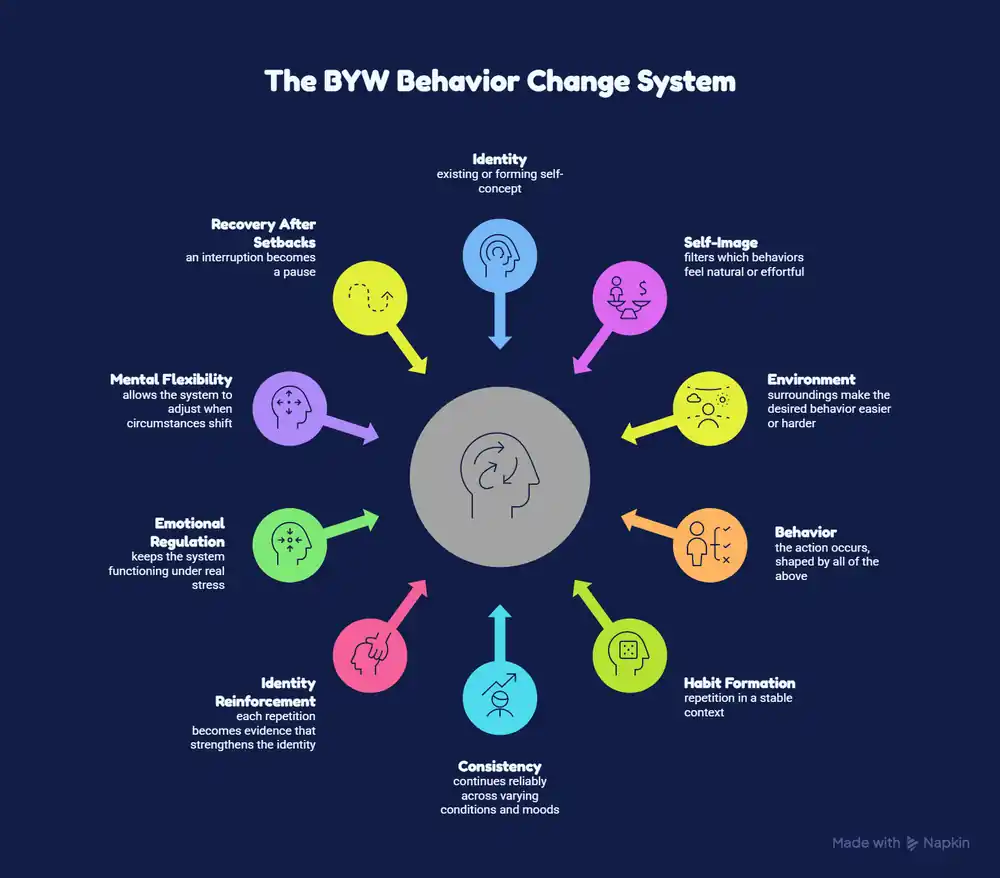
Put together, these pieces form a continuous, mutually reinforcing structure rather than a sequence of independent steps:
Identity → an existing or forming self-concept shapes what feels consistent to do.
Self-Image → that identity actively filters which behaviors feel natural or effortful.
Environment → surroundings make the desired behavior easier or harder before conscious choice is even involved.
Behavior → the action occurs, shaped by all of the above.
Habit Formation → repetition in a stable context reduces the conscious effort the behavior requires.
Consistency → the behavior continues reliably across varying conditions and moods.
Identity Reinforcement → each repetition becomes evidence that strengthens the identity it started from.
Long-Term Behavior Change → the cycle becomes self-sustaining rather than requiring constant active effort.
Three supporting loops run underneath this whole structure, strengthening or weakening it continuously: emotional regulation, which keeps the system functioning under real stress; mental flexibility, which allows the system to adjust when circumstances shift; and recovery after setbacks, which determines whether an interruption becomes a dead end or simply a pause.
What This System Looks Like in Everyday Life
Imagine you want to become someone who walks regularly.
You begin with a small commitment: a ten-minute walk after breakfast. You leave your walking shoes somewhere visible, making it easier to follow through. Repeating the walk after the same daily activity helps it become more familiar, while each completed walk gives you another reason to see yourself as someone who takes care of their health.
Then comes a difficult morning. You’re tired, running late, or simply not in the mood.
Instead of abandoning the routine, you adjust it. Perhaps you walk for five minutes or return to it the following day. The important thing isn’t maintaining a perfect record. It’s having a way to continue when circumstances change.
Notice how the different pieces support each other. Your environment makes starting easier. Repetition helps build the habit. Your growing self-image supports consistency. Emotional flexibility helps you adjust, and recovery prevents one missed day from becoming the end of the attempt.
The practical starting point: Choose one behavior you want to change, then ask yourself what would make it easier to start, repeat, and return to after an interruption.