

The new apartment doesn’t have the corner store on the walk home, the one that made stopping for a snack feel almost automatic. Three weeks in, the habit that felt genuinely difficult to break at the old place hasn’t shown up once here. Nobody fought it. Nobody white-knuckled through cravings. It simply had nowhere to attach itself anymore.
That’s an uncomfortable thing to notice, if you’ve spent years assuming the habit was a personal failing. It suggests something less flattering to the willpower story and more useful to actually understand.
Why Your Environment Shapes More Behavior Than You Realize
Research by psychologist Wendy Wood and colleagues offers a striking illustration of how much everyday behavior can become tied to recurring contexts. In one of their diary studies, about 43% of the behaviors participants reported were classified as habitual — behaviors performed almost daily and usually in the same location.
That doesn’t mean 43% of everything people do is completely unconscious or controlled by the environment. It does show how much repeated behavior can become connected to stable circumstances rather than requiring the same level of deliberate guidance each time.
Wood’s later research on habit strength offers another useful example. When students transferred to a new university, established behaviors such as exercising, watching television, and reading the newspaper were more likely to continue when important aspects of the performance context remained stable. When those contexts changed, strong habits were more likely to be disrupted.
The important point isn’t that intention stopped mattering. In fact, when familiar contexts changed, behavior could become more responsive to people’s intentions. The environment was helping determine whether an established habit had its usual cues available.
How Environmental Cues Influence Daily Actions
An environmental cue can be a feature of the surroundings associated with a particular behavior — a location, a time of day, another person, an object, or some other recurring part of the context.
Through repetition, features of a context can become associated in memory with a particular response. Research on habits suggests that encountering those familiar contexts can then activate well-practiced responses without requiring the same degree of deliberate goal-directed control each time.
This is part of why How Habits Are Formed: Why You Feel Stuck covers cue-based automaticity as central to how habits — wanted or unwanted — can take hold.
The corner store wasn’t necessarily defeating your discipline every evening. It may simply have been part of a familiar context repeatedly associated with the same behavior. Once the store disappears from the walk home, one of the cues connected with that pattern disappears with it.
Why Convenience Often Wins Over Motivation
Convenience does more quiet work than most people give it credit for.
One particularly clear example comes from research on default effects. Researchers Eric Johnson and Daniel Goldstein examined how default options affected decisions about organ-donor registration. Their work showed that whether people were placed into an opt-in or opt-out system could produce striking differences in donor agreement.
The choice itself was still available. What changed was which option required someone to take action.
This is part of the broader idea behind choice architecture: the way choices are structured can influence what people ultimately do without eliminating their freedom to choose.
The same principle can matter in ordinary life. When one behavior is easier, closer, or requires fewer steps than another, that difference in effort can influence which option gets chosen.
This connects directly to Why You Can’t Stay Consistent Even When Motivated. Motivation may give you a reason to act, but the structure of the environment can make following through easier or harder.
How Friction Makes Behaviors Easier or Harder
Friction refers to the effort standing between a person and an action — extra physical steps, time, inconvenience, paperwork, decisions, or other barriers that make something harder to do.
Behavioral research shows that changing these kinds of barriers can influence whether people follow through. Increasing effort can discourage an action, while reducing unnecessary barriers can make an intended action easier to complete.
That gives environmental design a practical role in behavior change.
If something repeatedly distracts you, for example, moving it out of immediate reach adds friction to the unwanted behavior. If you want to exercise in the morning, preparing what you need the night before removes some friction from the wanted behavior.
Neither strategy guarantees what you’ll do. It simply changes how easy each option is to act on.
How to Eliminate Distractions and Stay Disciplined explores this practical side in more depth — particularly how changing what is immediately available can reduce the amount of repeated self-control a situation demands.
Why Environment, Habits, and Identity Work Together
None of this means environment fully determines behavior.
People can act against environmental pulls, and goals, intentions, identity, resources, and other influences still matter. Habit research itself shows that habitual and goal-directed processes can interact rather than functioning as an either-or system.
Why Most Behavior Change Fails looks more broadly at the multiple influences that can support or interfere with change, while How to Change Your Identity When You Feel Stuck explores the identity side of behavior specifically.
Environment matters because it can make some actions easier to encounter, initiate, or repeat than others.
That changes the conditions under which intention has to operate.
If the food you want to eat is already prepared, the book you want to read is beside the bed, or the distracting app is no longer one tap away, your surroundings haven’t made the decision for you.
They’ve simply changed how much stands between you and each option.
And that is part of why Why Is Change So Hard? cannot be answered by looking at motivation alone.
The BYW Behavioral Environment Framework
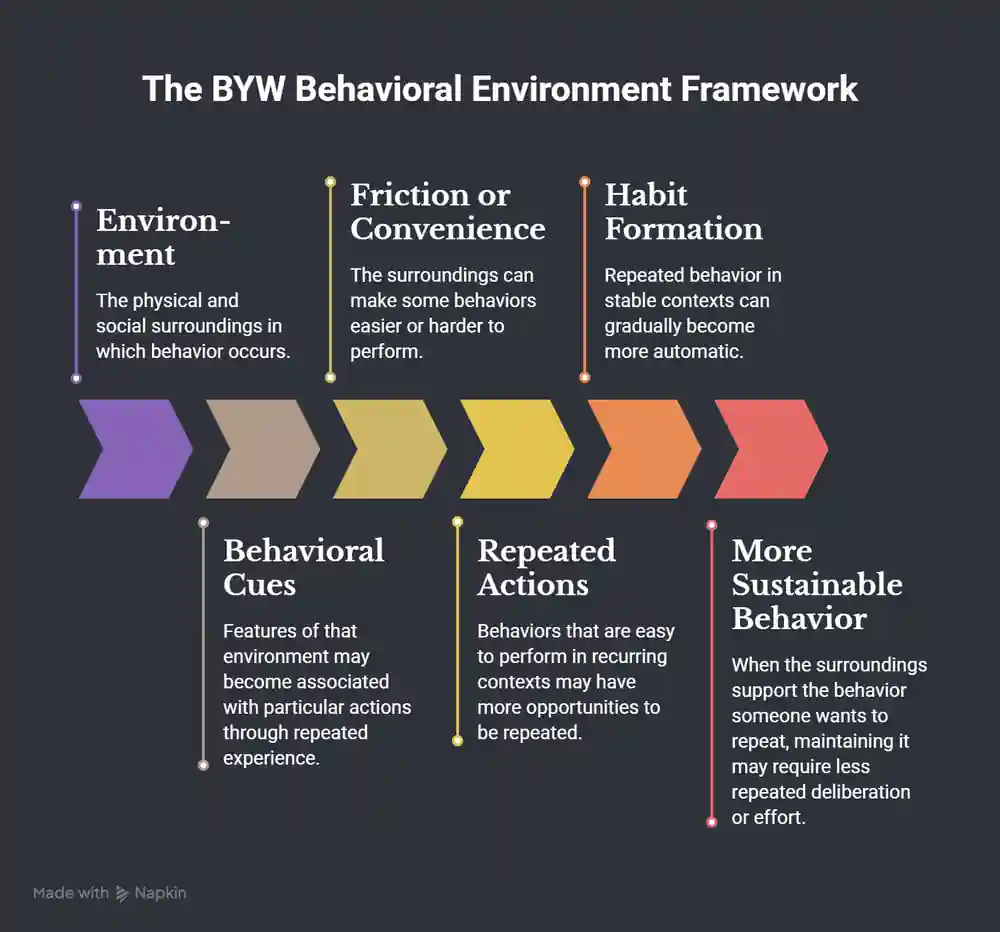
Put together, the research offers a useful way to think about how environment may support repeated behavior. This is a BYW synthesis of the research, not a demonstrated causal sequence:
Environment → the physical and social surroundings in which behavior occurs.
Behavioral Cues → features of that environment may become associated with particular actions through repeated experience.
Friction or Convenience → the surroundings can make some behaviors easier or harder to perform.
Repeated Actions → behaviors that are easy to perform in recurring contexts may have more opportunities to be repeated.
Habit Formation → repeated behavior in stable contexts can gradually become more automatic.
More Sustainable Behavior → when the surroundings support the behavior someone wants to repeat, maintaining it may require less repeated deliberation or effort.













One Response