

At some point, most people who struggle with self-sabotage manage to break the pattern — for a while. A few weeks of consistency. A project actually finished. A hard conversation actually had, instead of avoided.
Then, without much warning, the old pattern returns. And the moment it does, something worse than the relapse itself tends to happen: the person concludes that the whole effort was pointless. That they’re simply someone who can’t change. That the good weeks were the exception, and this is who they really are.
That conclusion is understandable. It’s also based on a flawed idea of what recovery is supposed to look like — one where success means a clean, permanent line from “struggling” to “fixed,” with no detours in between. Actual recovery from self-sabotage doesn’t work that way, and expecting it to is often what causes people to give up right when they’re closer than they realize.
This article lays out a framework for what recovery actually involves — not as a motivational push, but as a process with identifiable stages, including the one stage almost nobody plans for.
Where This Framework Comes From
If you’ve already read The Real Reason You Sabotage Your Own Success, you’re familiar with the basic cycle: a trigger creates emotional discomfort, an avoidance pattern brings temporary relief, and that relief quietly reinforces the pattern for next time. That cycle explains why self-sabotage happens. It doesn’t fully explain what it takes to exit it.
For that, it helps to borrow from a much older and more thoroughly tested area of psychology: how people recover from any deeply ingrained pattern, not just self-sabotage specifically. Researchers James Prochaska and Carlo DiClemente studied this question for years, originally in the context of smoking cessation, and developed what’s known as the Transtheoretical Model of behavior change — a framework describing the stages people consistently move through when changing an entrenched pattern, across everything from addiction recovery to chronic avoidance.
What makes this model useful here isn’t just the stages themselves. It’s the observation, built directly into the framework, that the process isn’t linear. Movement backward is expected. That single detail changes what “breaking the cycle” should actually look like in practice.
Modern behaviour-change research consistently shows that lasting change is rarely linear. Progress usually involves periods of growth, setbacks, adjustment, and renewed progress rather than one uninterrupted path forward.
The Self-Sabotage Recovery Framework
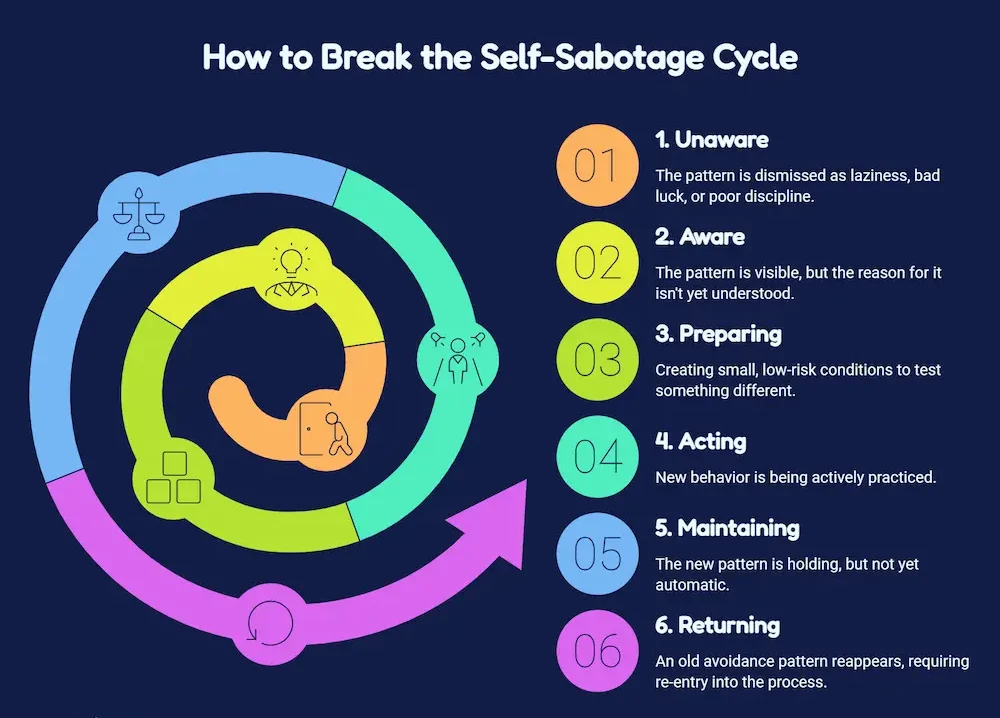 Adapted for self-sabotage specifically, the framework moves through six stages. Not everyone starts at the beginning, and almost nobody moves through it in a straight line — which is, itself, part of the point.
| Stage | What’s Happening | The Shift Required |
| 1. Unaware | The pattern is dismissed as laziness, bad luck, or poor discipline | Recognizing that a repeating pattern exists at all |
| 2. Aware | The pattern is visible, but the reason for it isn’t yet understood | Understanding what the behavior is protecting against |
| 3. Preparing | The reason is understood, but change hasn’t started yet | Creating small, low-risk conditions to test something different |
| 4. Acting | New behavior is being actively practiced | Interrupting the avoidance pattern earlier and earlier |
| 5. Maintaining | The new pattern is holding, but not yet automatic | Protecting the pattern without needing constant willpower |
| 6. Returning | An old avoidance pattern reappears | Re-entering the process without restarting from zero |
Stage 1 & 2 — From Unaware to Aware
Most people spend longer in the first two stages than they realize, because the pattern doesn’t announce itself as self-sabotage. It shows up as “I’m just not motivated right now,” or “This particular week was unusually busy,” said often enough that it starts to sound less like an excuse and more like a fact.
Awareness begins the moment those explanations stop holding up — when someone notices the same avoidance showing up right before the same kind of progress, over and over, regardless of how busy or motivated they happen to be that week.
Understanding the why behind that pattern is its own separate stage, and rushing past it tends to weaken everything that follows. This is where Why You Keep Sabotaging Yourself Without Knowing becomes useful — because trying to act your way out of a pattern you don’t yet understand usually means fighting the symptom while the underlying trigger stays completely intact.
Stage 3 — Preparing
This stage gets skipped constantly, usually because it doesn’t feel like progress. It’s the stage where someone understands what’s happening but hasn’t changed anything yet — and that gap can feel uncomfortable enough that people rush straight into action before they’re actually ready.
Preparation means lowering the stakes on purpose. Instead of committing to a complete behavioral overhaul, it means identifying one small, low-risk moment where the old pattern usually shows up, and deciding in advance what a slightly different response would look like. This stage is quiet and undramatic. It’s also where most of the actual groundwork for lasting change gets laid.
Stage 4 — Acting
This is the stage most self-help content focuses on almost exclusively — the actual moment-to-moment work of catching the avoidance pattern before it fully takes over. For practical, in-the-moment techniques for this stage specifically, How to Stop Self-Sabotaging Yourself covers this territory directly.
What’s worth adding here is a subtler point: the goal in this stage isn’t to eliminate emotional discomfort before acting. It’s to act while the discomfort is present, in smaller doses than before. Each time that happens, the pattern that once said “discomfort means retreat” gets a small piece of contradicting evidence.
Stage 5 — Maintaining
Maintenance is where the new pattern stops requiring constant conscious effort — not because willpower increased, but because enough repetition has occurred that the behavior no longer feels like a decision every single time.
This stage is fragile in a specific way: it’s easy to mistake the reduced effort for the pattern being “finished,” which leads to dropping the very conditions that made maintenance possible in the first place — the small preparations, the earlier catches, the lower-stakes practice. Maintenance isn’t the finish line. It’s a stage that still requires attention, just less of it.
Building an identity that supports these new behaviors can also make long-term maintenance easier. You Don’t Change Habits: You Change Identity First explores why lasting change becomes more sustainable when repeated actions gradually reshape how you see yourself.
Stage 6 — Returning
Here is the stage almost nobody accounts for in advance, and it’s the one that determines whether recovery actually lasts.
At some point — after a stressful week, a bigger-than-usual trigger, or simple fatigue — the old avoidance pattern will very likely reappear. This doesn’t happen because all progress has disappeared. Older behavioral patterns are usually more familiar to the brain, especially during periods of stress or mental fatigue. Returning to them says more about how the brain falls back on familiar coping strategies than about whether meaningful change has actually taken place.
In most popular narratives about change, this gets labelled as relapse, failure, or proof that nothing really changed. In the research this framework is built on, it’s labelled something else entirely: an expected, common stage of the process itself, not evidence that the process didn’t work.
The difference in how this moment gets interpreted has enormous consequences. Treating a return to old patterns as proof of failure tends to trigger exactly the kind of shame and self-criticism that made the original pattern feel safer in the first place — pulling someone back toward stage 1, unaware, or keeping them stuck in a cycle of quitting entirely. Treating it as an expected stage — one that means re-entering at preparing or acting, not starting over completely from the beginning — tends to shorten the return considerably.