

The appointment has been on your list for eight months. You know the number to call. You know it takes maybe four minutes. You’ve thought about it more times than the task itself would ever take to complete, and somehow that thinking has never once turned into dialing the phone.
There’s no confusion here. No missing information. If someone asked what you should do, the answer would arrive instantly and without hesitation. And still, the calling never happens — which is a strange, specific kind of frustration, because it doesn’t feel like not knowing. It feels like knowing perfectly well and somehow not being able to use it.
Why Knowing Isn’t the Same as Doing
That frustration has a very particular shape. It isn’t uncertainty about the right move — there’s total clarity about the destination. It’s the difficulty of actually moving toward it despite that clarity.
Behavior research has documented this disconnect between what people intend to do and what they ultimately do. And importantly, the gap doesn’t necessarily mean the original intention wasn’t genuine.
It has a name: the intention–behavior gap, closely related to what we’ll call the knowledge–action gap here.
What Is the Knowledge–Action Gap?
The knowledge–action gap describes the well-established finding that knowing what to do, and even genuinely intending to do it, does not reliably predict whether someone actually does it. This is closely related to what researchers call the intention–behavior gap — the documented distance between forming a real intention and following through on it.
The size of this gap is larger than most people assume. In a major review drawing together evidence from hundreds of studies, researcher Paschal Sheeran found that intentions accounted for only about 28% of the variation in behavior. In other words, having a genuine intention matters, but it leaves much of what determines actual behavior unexplained. The research also showed that an important part of the intention–behavior gap comes from people who intend to act but ultimately don’t follow through.
The appointment sitting untouched for eight months wasn’t evidence of insincerity. It was, statistically, closer to the norm.
Why Knowledge Rarely Creates Action
Knowledge and intention function as an early, cognitive stage of a much longer process. They establish what should happen and create a genuine, felt commitment to it. What they don’t automatically address are the conditions required to actually carry that commitment out in a specific, real moment — one that might involve competing demands, a different emotional state than the one in which the intention was formed, or a task that quietly feels heavier than the four minutes it would objectively take.
There’s a specific reason that last part can matter more than it seems. Research on temporal discounting shows that people tend to value outcomes less when those outcomes are delayed. That can create an imbalance in moments like this: making the call carries a small discomfort right now, while whatever benefit the appointment may bring sits somewhere in the future. Even when the future benefit matters more, the immediate discomfort can exert a surprisingly strong pull on what happens in the present moment.
The Hidden Barriers Between Knowing and Doing
Several factors sit in the space between a genuine intention and consistent follow-through, and they rarely announce themselves clearly in the moment.
Identity can sometimes create friction as well. An action may feel harder to follow through on when it conflicts with an established way of seeing yourself or behaving — for example, wanting to deal with something you’ve habitually avoided. That doesn’t make identity the sole explanation for the gap, but it can be one part of the conditions surrounding whether an intention becomes action.
Environmental friction is another. An intention formed in a calm, reflective moment often doesn’t account for the actual environment where it needs to be executed — one with more distractions, less time, or more competing priorities than the moment the intention was formed in.
Identity can sometimes create friction as well. An action may feel harder to follow through on when it conflicts with an established way of seeing yourself or behaving — for example, wanting to deal with something you’ve habitually avoided. That doesn’t make identity the sole explanation for the gap, but it can be one part of the conditions surrounding whether an intention becomes action.
None of these barriers are visible at the moment an intention is formed, which is exactly why they’re so easy to underestimate. This is part of the broader system explored in Why Most Behavior Change Fails, which looks at how capacity, drive, and environment interact more generally — the knowledge-action gap is one specific, well-studied version of that larger pattern.
Why Learning More Usually Doesn’t Solve the Problem
A common response to this gap is to seek more information — another article, another explanation of why the task matters, another reason it should get done. But when someone already understands what they need to do, more information may not address what is interfering with follow-through. The difficulty may instead lie in the conditions surrounding the action — including immediate versus delayed consequences, environmental friction, competing demands, or patterns that make the intended behavior harder to carry out.
This is worth stating plainly, because it corrects a common misconception. When someone already understands what they need to do, more knowledge alone may not close the gap. The more useful question becomes: what is making this intention difficult to carry out when the moment to act actually arrives?
How to Close the Knowledge–Action Gap
One of the best-studied strategies for helping intentions translate into action comes from psychologist Peter Gollwitzer’s research on implementation intentions — specific plans that connect a situation or cue with an intended response. Instead of simply intending to “call and schedule that appointment,” you might decide: “When I finish lunch tomorrow, I’ll call from my desk before opening my laptop.” By specifying when and how you’ll respond, an implementation intention can make it easier for the intended action to be initiated when the relevant moment arrives.
Implementation intentions are one way to make an intended action more concrete, but follow-through can also depend on the conditions surrounding the behavior. Reducing friction, making the next action easier to begin, and creating clearer cues can help turn an intention into something more actionable. Why Is Change So Hard? explores the broader reasons familiar patterns can be easier to repeat than unfamiliar ones, even when you genuinely want to change.
Closing the gap once is different from making an action repeatable. When the goal is to turn repeated follow-through into something more automatic, How to Build Habits That Actually Stick explores what helps a behavior become easier to repeat over time.
The BYW Knowledge–Action Framework
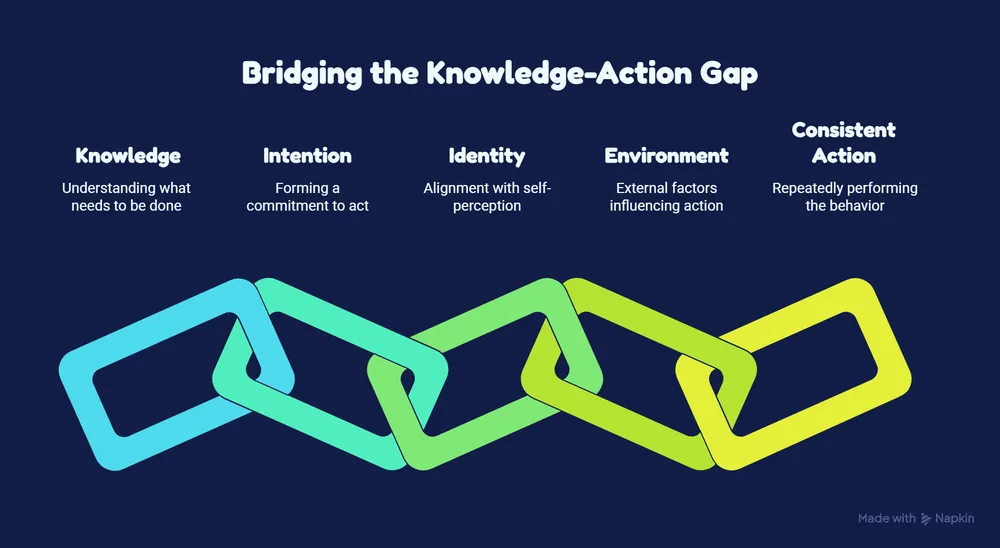 Put together, the path from knowing to doing runs through several distinct stages, and each one can break independently:
Knowledge → understanding what should happen. Intention → forming a genuine commitment to do it. Identity → whether the action aligns with how you see yourself. Environment → whether your surroundings make the action easier or harder than the alternative. Consistent Action → the behavior actually occurring, repeatedly, over time.
The critical insight this framework adds is that knowledge and intention are only the beginning. More information or stronger motivation may strengthen an intention without resolving whatever is interfering with follow-through. Looking at the conditions around the behavior — including personal patterns, environmental friction, competing demands, and the cues available when it’s time to act — can reveal why a genuine intention still isn’t becoming consistent action.













2 Responses