

Interrupted mid-sentence at a family dinner, your response comes out fast and sharp, almost word-for-word what you said the last time this happened. Three days later, you’re interrupted in a work meeting — a different room, a different person, completely different circumstances — and that same clipped tone appears again.
It can feel almost rehearsed. You recognize the response, perhaps even regret it afterward, yet find yourself reacting similarly the next time.
It’s tempting to conclude that this is simply your personality. You’re someone who gets irritated when interrupted, and that’s just how you are.
But another possibility is worth considering: the way you respond to certain emotional triggers may have become a familiar, learned behavioral pattern.
Why Emotional Reactions Can Feel Automatic
Some emotional reactions happen so quickly that we barely notice the space between what happened and how we responded. Someone interrupts us, questions our decision, or makes a remark that feels dismissive, and our tone changes before we’ve had much opportunity to consider another response.
This doesn’t necessarily mean the reaction is entirely unconscious or that it developed through repetition alone. Temperament, past experiences, current stress, and the meaning we assign to a situation can all influence how we respond.
Still, when a similar situation repeatedly brings out a familiar response, it may be useful to examine whether a learned pattern is involved.
The important distinction is between feeling an emotion and what we habitually do when that emotion appears.
You may not deliberately choose to feel irritated when interrupted. But speaking sharply, withdrawing, becoming defensive, or immediately arguing are behavioral responses that may be influenced by learning and experience.
Recognizing that distinction creates room to understand the pattern without assuming the emotion itself is simply a bad habit.
How Emotional Triggers Can Become Associated With Responses
Behavioral psychology has long studied how experiences can become associated with emotional reactions.
One foundational concept is the conditioned emotional response, investigated in early learning research, including work by William Estes and B. F. Skinner in 1941.
In classical conditioning, a stimulus that initially produces little or no particular response may come to evoke a learned reaction after being associated with another meaningful stimulus.
This research helps explain how emotional responses can become associated with cues through learning.
However, early conditioned-response experiments do not directly establish how complex interpersonal reactions — such as becoming defensive or speaking sharply when interrupted — develop in everyday relationships.
Those reactions involve additional influences, including interpretation, social context, and previous experience.
For example, imagine someone who has repeatedly experienced interruptions as dismissive. Over time, being interrupted may become strongly associated with feeling unheard or undervalued.
A later interruption might bring up a similar emotional response, even when the other person’s intention is different.
That doesn’t prove the reaction was produced by classical conditioning alone. But learned associations may contribute to how the situation is experienced.
Emotional Triggers: Why You React So Deeply explores how particular situations can acquire emotional significance and why seemingly ordinary interactions sometimes provoke strong reactions.
Why Repeated Emotional Behaviors Can Become Habit-Like
There is another part of the pattern worth examining.
Even when an emotion arises quickly, the behavior that follows may become familiar through repetition.
Research on habits suggests that repeatedly performing behaviors in consistent contexts can strengthen associations between situational cues and responses.
In their review, Psychology of Habit, researchers Wendy Wood and Dennis Rünger describe habits as responses that can be activated relatively automatically by recurring contextual cues.
This helps explain why certain behaviors may occur with less deliberate decision-making after repeated practice.
But we should distinguish that finding from a broader claim that every repeated emotional reaction automatically becomes a habit.
For example, feeling irritated when interrupted isn’t necessarily a habit in the same sense as automatically reaching for your phone when a notification appears.
However, responding to irritation by raising your voice may become a familiar behavioral tendency, particularly if it repeatedly occurs in similar situations.
This connects with How Does Your Environment Affect Your Behavior?, which explores how contextual cues influence repeated actions.
The key idea isn’t that emotions and habits are identical. It’s that some behaviors performed in response to emotions may develop habit-like characteristics.
How Reinforcement May Maintain a Repeated Response
Repetition isn’t the only learning process worth considering.
Consequences can also influence whether a behavior is repeated.
Imagine someone who speaks sharply when interrupted. If the other person immediately stops talking, the sharp response may sometimes produce a consequence the speaker finds relieving or useful.
Under certain conditions, that consequence could reinforce the behavior, making a similar response more likely in the future.
But this isn’t automatic.
The effect depends on the circumstances, the person’s experience of the consequence, and whether the response is actually reinforced over time.
A sharp response might also create conflict, embarrassment, or regret, which could influence future behavior differently.
This is why we shouldn’t assume that every repeated emotional response persists because it provides relief.
10 Emotional Triggers That Control Your Behavior explores several situations in which emotional triggers and behavioral responses can become closely connected.
Recognizing the possible role of consequences can help us ask a useful question:
What tends to happen immediately after I respond this way?
How the Emotion–Habit Pattern May Develop
Consider the dinner-table example again.
Someone interrupts you while you’re explaining something important. You interpret the interruption as dismissive, feel irritated, and respond sharply.
A few days later, something similar happens at work.
You notice the same irritation and respond in a familiar way.
Perhaps this pattern has occurred many times before. Perhaps the response has sometimes helped you regain the conversation, or perhaps it simply reflects how you’ve learned to handle feeling unheard.
Over time, a particular way of responding may become increasingly familiar.
But the sequence isn’t inevitable.
The emotional meaning of the interruption may differ across situations. Your response may also change depending on the relationship, your current state, and how you interpret the other person’s behavior.
Rather than assuming every emotional reaction follows a fixed loop, it is more useful to think of repeated responses as patterns that may be influenced by learned associations, behavioral repetition, and consequences.
And because behavior can change through new experiences and practice, an established response doesn’t necessarily have to remain the only response available.
Why Awareness Can Help You Respond Differently
When a familiar emotional response happens quickly, it can be difficult to notice the pattern before you’ve already acted.
This is where awareness becomes useful.
You might begin by noticing what typically happens just before the reaction.
Is it being interrupted?
Feeling criticized?
Having your intentions questioned?
Being told what to do?
Then consider what you usually do next.
Do you raise your voice, withdraw, explain yourself defensively, or become unusually quiet?
The aim isn’t to eliminate the emotion or criticize yourself for having it.
It’s to recognize the connection between the situation, your interpretation, and your behavioral response.
How to Control Emotional Triggers Before They Control You explores practical ways to notice emotional reactions and create opportunities for more deliberate responses.
A pause can sometimes help you choose what to do next, although it isn’t always possible to interrupt a strong reaction immediately.
For example, when interrupted during a meeting, you might notice the familiar irritation and say, “I’d like to finish my point first.”
You’re still responding to the interruption.
But you’re practicing a different behavioral response.
This is also relevant to Why Work Triggers You More Than You Think, where workplace expectations, relationships, and interpretations can influence emotional experiences.
The goal isn’t to become someone who never feels irritated.
It’s to develop more options for how you respond when irritation appears.
The BYW Emotion–Habit Framework
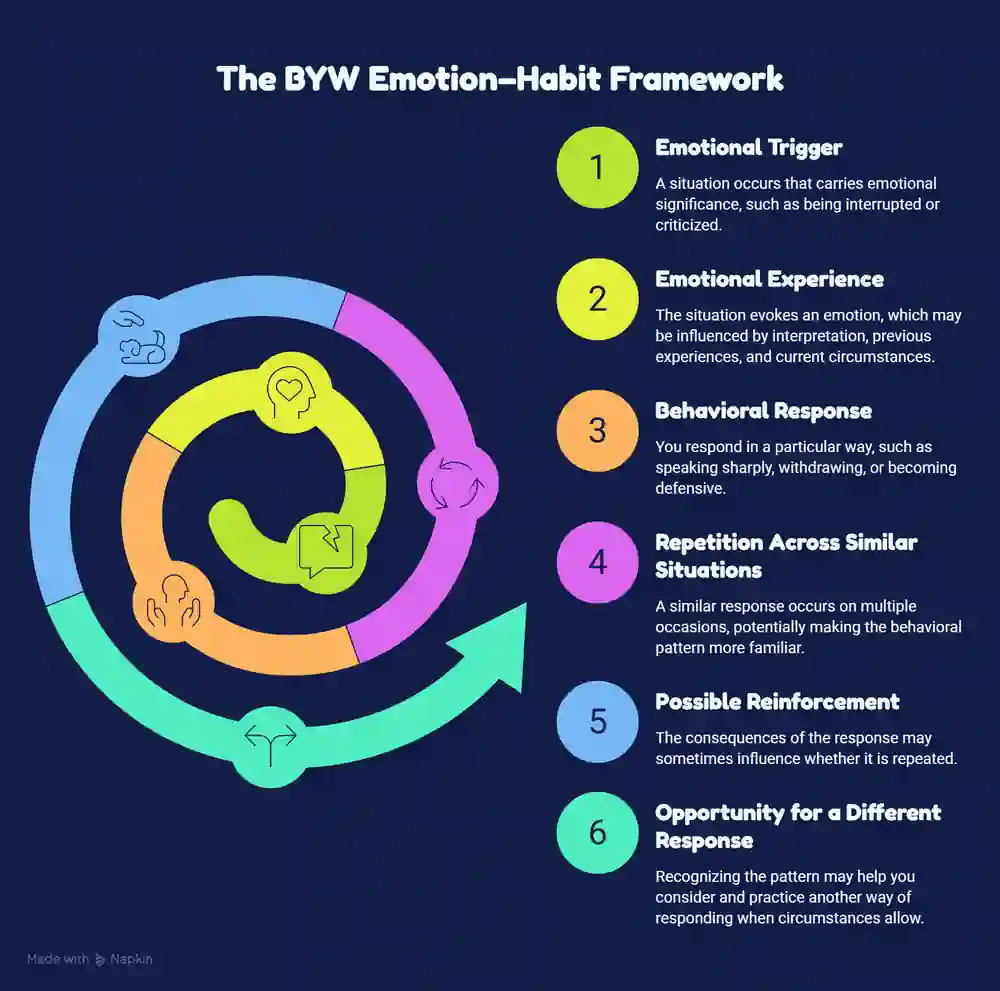
The BYW Emotion–Habit Framework is a practical synthesis for examining repeated emotional-behavioral patterns. It is not a validated psychological model or a universal causal sequence.
It brings together several concepts that may be relevant when a familiar situation repeatedly produces a familiar response.
1. Emotional Trigger
A situation occurs that carries emotional significance, such as being interrupted or criticized.
2. Emotional Experience
The situation evokes an emotion, which may be influenced by interpretation, previous experiences, and current circumstances.
3. Behavioral Response
You respond in a particular way, such as speaking sharply, withdrawing, or becoming defensive.
4. Repetition Across Similar Situations
A similar response occurs on multiple occasions, potentially making the behavioral pattern more familiar.
5. Possible Reinforcement
The consequences of the response may sometimes influence whether it is repeated.
6. Opportunity for a Different Response
Recognizing the pattern may help you consider and practice another way of responding when circumstances allow.
These elements do not always occur in this order, and not every repeated emotional reaction involves conditioning or reinforcement.
The framework is intended to help you examine a familiar response rather than diagnose its cause.